July 2025
My first ever attempt at vibe coding a video. Had to start off with some Tron Lightcycles.
I saw a post from @trq212 about how you can vibe code videos using remotion. I immediately had to give this a try for myself.
My Workflow
First, I went straight to the docs and had Grok 4 give me a detailed document on how to use remotion. This was critical to getting my ai agent, Amp, to know what it was dealing with here.
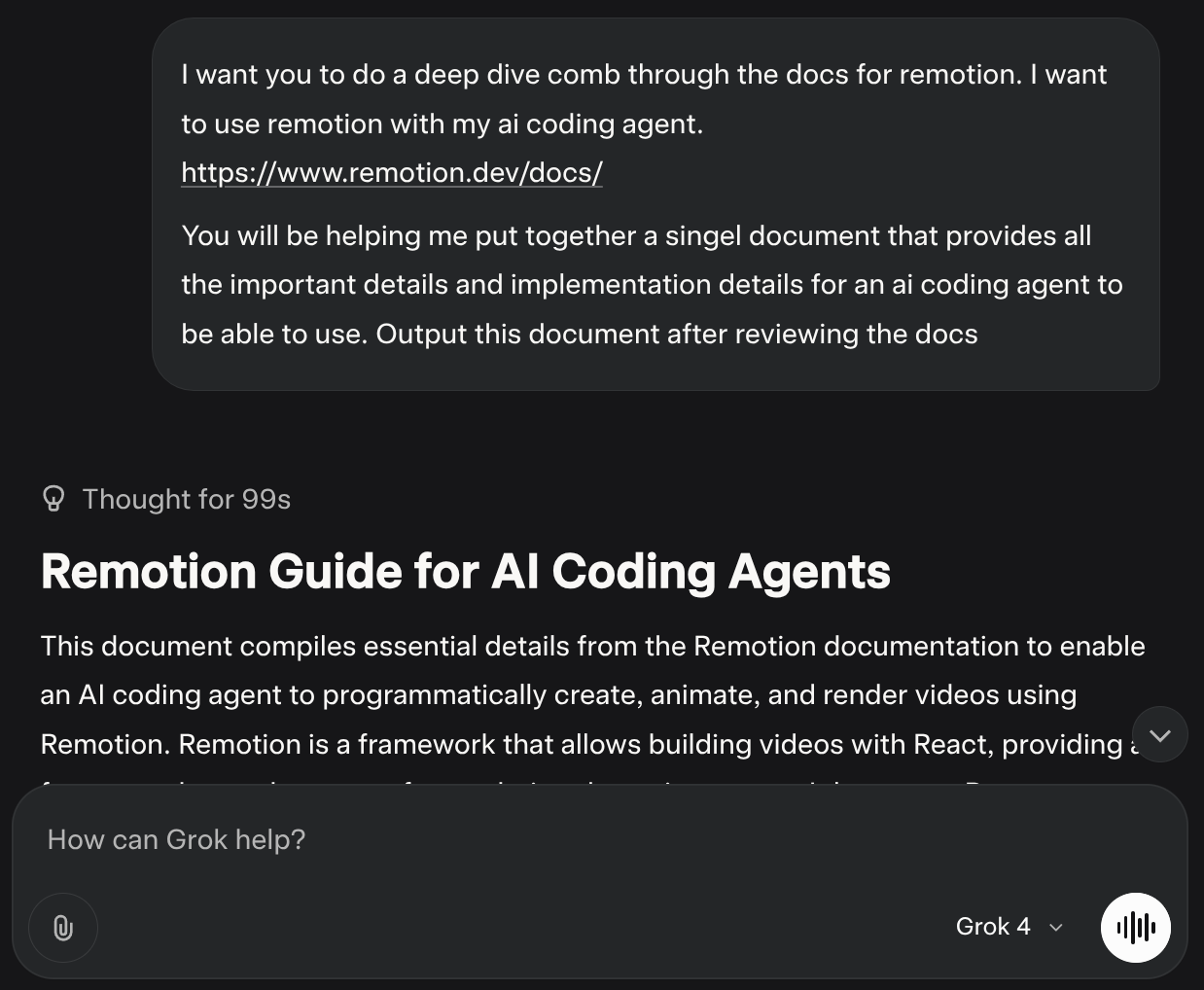
Next, I have this to document to amp, and had the oracle review it and give me an implementation plan for the following idea:
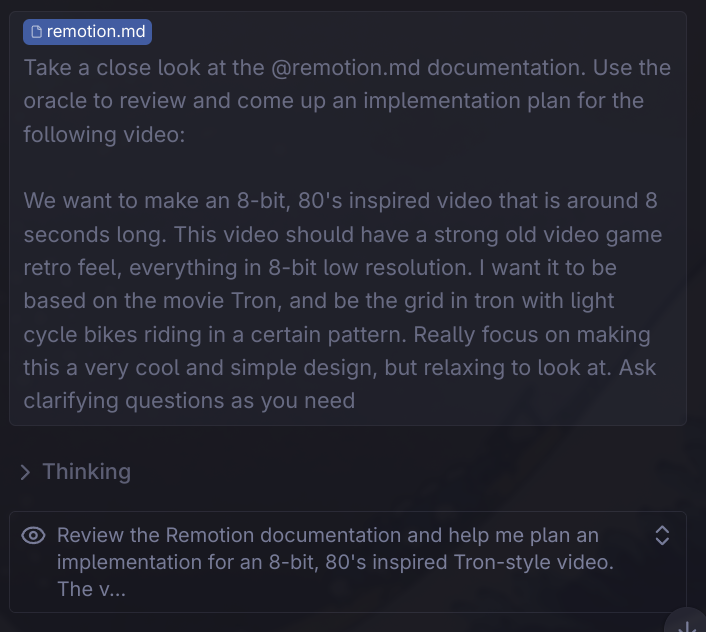
Amp actually gave me some pretty good follow up questions to learn exactly what I wanted from the video. It asked things like:
Clarifying Questions:

1.Bike Behavior: Should the light cycles:

Move in perfect loops/rectangles like classic Tron?
Cross paths and create interesting intersections?
Move at the same speed or have some variation?
Color Scheme: For the 80's aesthetic, do you prefer:

2. Classic cyan/orange Tron colors?
Neon pink/purple/yellow combinations?
Multiple bike colors or stick to 2-3?
Grid Style: Should the grid be:

3. Static with subtle flicker?
Pulsing/breathing effect?
React to the bikes passing over it?
Audio: Would you like me to include:

4. A simple 8-bit background track?
Sound effects for bike movement?
Pure visual experience?
Resolution: The Oracle suggests a 240×135 virtual canvas scaled up 8x. Is this pixelated enough, or would you prefer even chunkier pixels?
The final result: Not great, but still cool
This was just a first try, but it gave me a pretty bad video. The grid was there and the colors were right, but the racing around motorcycles were far from my Tron dream. It reminds me of when I first started learning to use LLM’s to help me code. I could tell I needed to do a much better job of context engineering than I had been doing. But that’s the great part is I’m not done yet, I plan to keep trying to learn how to use these image and video generating tools to make some awesome content. I will do a post later on some cool things I have been able to make with whisk .
Today I learned about some powerful, lesser-known features of uv
, a fast Python package and environment manager. Beyond the usual uv venv and uv sync, uv offers commands that streamline workflows for tool management, Python versions, and reproducible builds. Here’s a quick overview of some standout features:
Running ruff directly
# Install CLI tools globally in isolated environments (like pipx, but faster)
uv tool install ruff
# Run tools ephemerally without permanent installs
uvx ruff check
Manage Python versions directly
# Install specific Python versions
uv python install 3.10 3.11
# List installed versions
uv python list
# Upgrade to latest patch release
uv python upgrade 3.10
Compile requirements for reproducible builds
# Generate a pinned lockfile
uv pip compile requirements.in -o requirements.txt --universal
# Pre-compile bytecode for faster container startup
uv pip compile requirements.in -o requirements.txt --compile-bytecode
Run commands with automatic environment syncing
# Auto-sync dependencies before running
uv run ruff check
# Use non-editable installs for production-like setups
uv run --no-editable python script.py
Build and package Python distributions
# Create source distribution and wheel
uv build --wheel
# Skip build isolation for tricky dependencies
uv build --no-build-isolation-package numpy
I have really liked using uv in my work and personal projects. It’s no secret it is becoming the best way to manage Python dependencies. Knowing some of the other things uv can do helps make developing in Python that much more enjoyable.
Check the uv docs for more details.
I have been using RepoMix on and off for projects on Github, but I never knew they had a CLI for it. It’s extremely useful and easy to setup. I was using a custom python script but the repomix cli is much easier to work with.
There are a bunch of useful commands. Here is a quick overview:
# Install using npm
npm install -g repomix

# Then run in any project directory
repomix
Pack specific files or directories
repomix --include "src/**/*.ts,**/*.md"
Exclude specific files or directories
repomix --ignore "**/*.log,tmp/"
Pack remote repositories
npx repomix --remote https://github.com/yamadashy/repomix
Initialize new config file
repomix --init
Choose your output style
# XML format (default)
repomix --style xml

# Markdown format
repomix --style markdown

# Plain text format
repomix --style plain